Mostrar mensagens com a etiqueta The Time. Mostrar todas as mensagens

segunda-feira, 28 de dezembro de 2009

O Twitter na Time

DIGESTIVOS >>> Internet

Segunda-feira, 28/12/2009
Internet
Julio Daio Borges
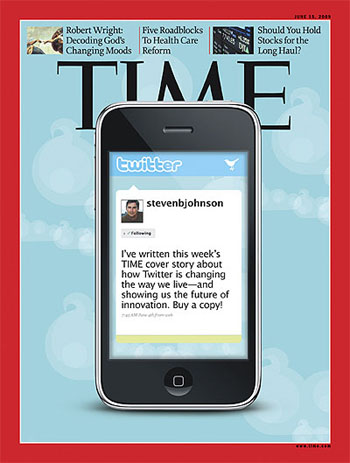


Digestivo nº 419 >>> O Twitter na Time
Enquanto os jornalistas brasileiros classificam o Twitter como “uma besteira”, os da Time afirmam, na capa da revista, que o mesmo Twitter “vai mudar nosso jeito de viver”. Um exagero de ambos os lados. No caso do Brasil, um exagero em matéria de desinformação. E, no caso dos EUA, um exagero calculado, para vender mais exemplares na banca. Afinal, conforme a própria Time estima, são 32 milhões de usuários no Twitter neste momento. E o serviço vem crescendo de 50 a 100% mensalmente. A expectativa é de que alcance 50 milhões no final deste ano (vale lembrar que o Facebook tem 200 milhões). Abocanhar uma parcela disso – quando as maiores revistas têm tiragem de um milhão – é um grande feito, não é? A Time começa fazendo uma piada, pelo fato do Twitter causar uma “má primeira impressão”. Valoriza o que o microblog proporciona em termos de “ambient awareness” (algo como “consciência do ambiente” ou, numa tradução livre, “percepção do zeitgeist”), expressão de Clive Thompson. Sugere que o interesse reside não “no Twitter em si”, mas “no que estamos fazendo hoje com ele”. Na interpretação de Ashton Kutchermais de 2 milhões de “seguidores” –, seria o fato do Twitter não ser, exatamente, a “soma” de instant messaging (nosso MSN) com rede social (nosso Orkut). A Time se rende, finalmente, classificando muitos dos tweets (ou microposts) como “tocantes”, “engraçados”, “argutos” e “irreverentes”. Sua ameaça ao Google, segundo John Battelle, estaria na possibilidade do Twitter revelar a “super fresh” Web ou a “internet em tempo real” (que a poderosa ferramenta de busca, atualmente, não revela). O mesmo Facebook já ofereceu 500 milhões pela startup de Evan Williams, Jack Dorsey e Biz Stone. Não é, decididamente, “uma besteira”. Mas será que vai nos mudar mais do que já mudamos nestes últimos anos (© @dudafleury)? 
>>> How Twitter Will Change the Way We Live

domingo, 20 de dezembro de 2009

Books: Child Soldiers - The Bridge por Manfred Gregor


CNN.com
Monday, Aug. 15, 1960
.
.
THE BRIDGE (215 pp.) — Manfred Gregor — Random House ($3.50).
.
On one side of the bridge crouched seven German teen-agers with only two weeks of military training. On the other side was a combat patrol of battle-hardened G.I.s supported by three Sherman tanks, artillery and planes. The result? Two U.S. tanks destroyed, a scatter of U.S. dead in the street and, finally, a crestfallen U.S. withdrawal to allow planes and artillery to soften up the remaining schoolboy defenders.
.
This bloody skirmish serves Germany's Manfred Gregor as the core of his first novel. Like his seven heroes, Author Gregor was called up from high school during the spring of 1945 in the desperate mass conscription of 16-year-olds designed to flesh out the shattered Nazi armies. As U.S. armored columns knifed their way into Germany, they frequently encountered such youngsters, callously thrown into the front lines. Most often the dazed and frightened teen-agers surrendered in tears without firing a shot. But occasionally, they put up astonishing resistance. How they behaved usually depended on the quality of their leadership.
.
The hero of Gregor's book is Ernst Scholten, a schoolboy who cares little about the war and less about politics. A passionate reader of Karl May's cowboy-and-Indian stories,* Scholten imagines himself as the dauntless Indian chief, Winnetou. Even though German adults — both soldiers and civilians—urge the uneasy boys to desert, they blindly follow Scholten's lead. "You can do as you please," he says. "I am staying. Winnetou will hold the fort." The boys' resolution is strengthened when a passing general cannot resist spouting nonsense: he urges them to defend the bridge and announces that with a few thousand like them, Germany might still win the war.
.
Twelve hours later, only Scholten and one other teen-ager are left alive. When a truckload of German troops arrives, the boys think they are replacements to take over their position. Discovering that the unit is really a demolition team come to blow up the bridge, Scholten cries hysterically: "Why did we have to defend it, then? Five are lying over there who've fought for this bridge." Author Gregor's final irony: after driving the demolition squad away from "our" bridge, Scholten is killed by a fellow German.
.
The Bridge is briskly told with an interlacing of flashbacks. Since the major characters are 16-year-olds, these flashbacks are mercifully short, if overly sentimental; the boys seem to have grown up surrounded by sweet, long-suffering mothers and avuncular lieutenants, with hardly a Nazi in sight. But these scenes from the boys' past merely serve as counterpoint to the adventure at the bridge and as clues to the variety of boyish responses, which range from terror to heroism. Gregor's bitter little novel labors no point, nor does it have to. The futility it illustrates would have been depressing enough even if it had been grown men who held the bridge. Its special dimension of bitterness grows, without overstatement, from the fact that children suddenly forced into men's roles have only their childhood with which to face death.
.
* Though he never visited the U.S., May wrote dozens of volumes on the American West which have been devoured by generations of German schoolboys.
.
http://www.time.com/time/magazine/article/0,9171,939797,00.html